
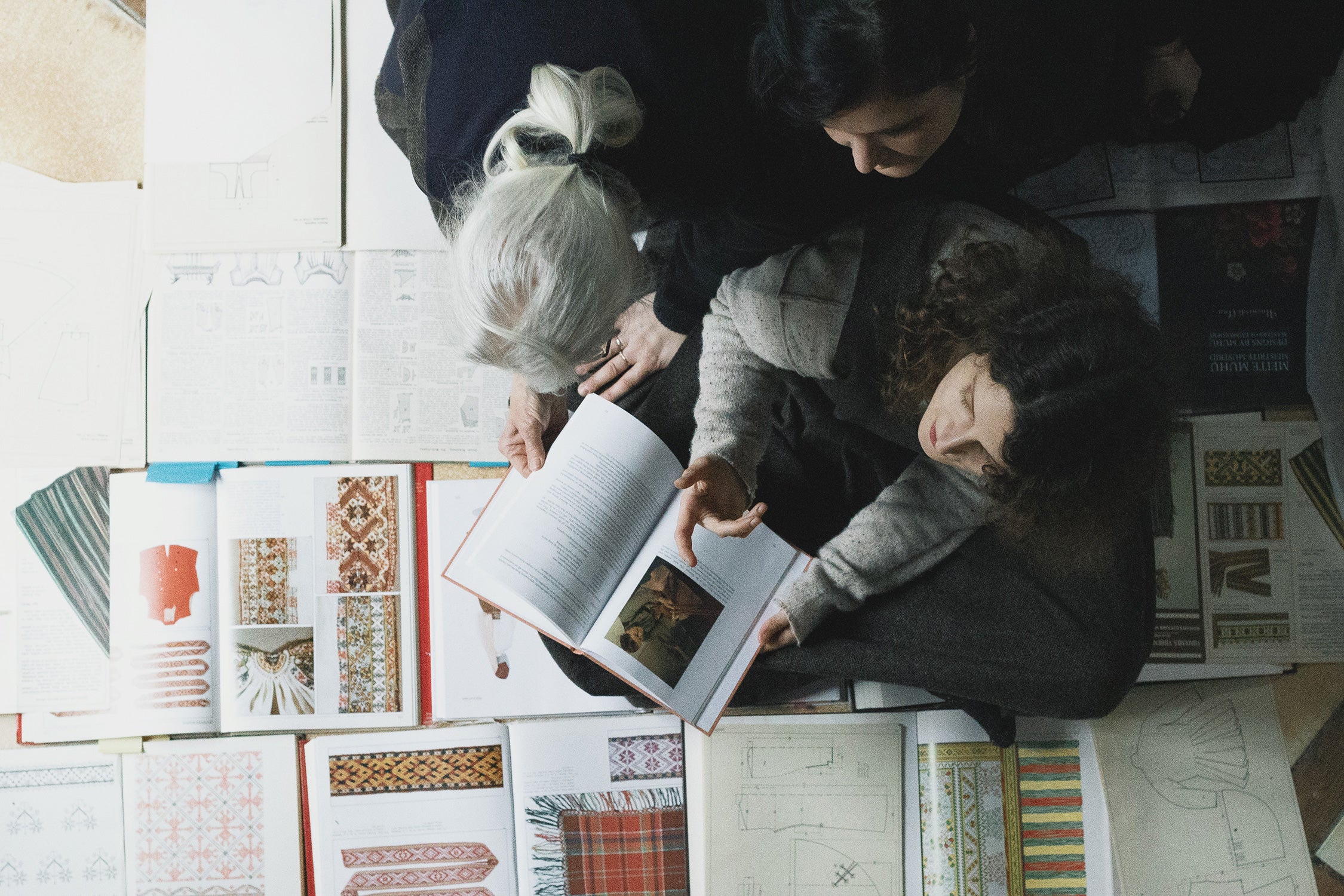

The Sisters (and Mom)
At Voriagh, time stays still. Born at the edge of the Fontainebleau forest, the family house creates garments that carry within them the memory of Slavic, Baltic and Nordic folklores. Each piece is inhabited by material, by seasons, by the patient gesture of those who embroider. At the heart of this approach beats a demand: that of ethnographic research and of motifs which decorate, but also protect, symbolize and transmit.
A Family Story, Two Places: The Forest and Paris
Voriagh was born from the shared impulse of two sisters, Olivia and Vivien, and their mother, Bruna. The sisters are classically trained violinists specializing in early music, a discipline that taught them patience, precision and respect for tradition. Bruna, a seamstress, passed down more than technical knowledge: she taught her daughters embroidery, sewing and the traditional techniques tied to their family's origins across Central and Eastern Europe, regions like the Tyrol, the Balkans and Hungary. These were skills of course, but also inheritance, memory made tangible through thread and fabric.
Olivia creates each piece of jewelry by hand. Crafted from silver and gold fill, the pieces draw from the same folk symbols and patterns that run through the collections. Small, slow and detailed work: the kind that asks one to be fully present.
The house flourishes at the edge of Fontainebleau forest, in a landscape that has nourished imagination since always: damp moss underfoot, rough bark, clearings where light pierces, inhabited silence.
In Paris, Voriagh has a single space in the 10th arrondissement. A place conceived as an encounter rather than a boutique. One comes to try, to touch, to understand the construction of a piece, to feel the weight of fabric. To rediscover what clothing can have of tangible and of true in a world where everything tends toward the immaterial.
Cultural Respect
Before pencil touches paper, there is observation. Long and meticulous. The sisters look at ancient pieces, their seams, their wear. They pore over popular iconography, yellowed photographs, collections sleeping in museums. They read archives. This research is not ornamental: it allows them to grasp context, to understand use and to decipher the symbolism of a detail before welcoming it into a modern creation.
This approach also demands constant vigilance. To respect the cultures from which inspiration is drawn, not to yield to the temptation of easy appropriation, to refuse the simplification that impoverishes. References are never treated as ephemeral trends, but as heritage of which we are custodians. To borrow requires care, contextualization and the kind of humility which acknowledges that one never truly possesses what one has received.

The sisters’ connection to these traditions carries a particular legitimacy. Olivia, Vivien and Bruna's ancestry reaches back to four regions in Central and Eastern Europe, where folk traditions run deep. The techniques Bruna taught her daughters were passed down through generations: embroidery patterns, construction methods, seasonal rituals woven into cloth. The sisters work from inside this memory, creating their own visual language while never reproducing sacred or culturally specific symbols that belong to communities beyond their lineage. It's a practice of remembering, not taking.
At times, they do not carry this responsibility alone. Their collaborators bring their own years of study and closeness to these traditions. Mariëlle, who is completing her doctorate in ethnography, is one of them. Her insights and deep familiarity with the folk world keep the work honest and mindful of all that lives beyond the surface.


